A Dungeon Master’s Guide to Teaching

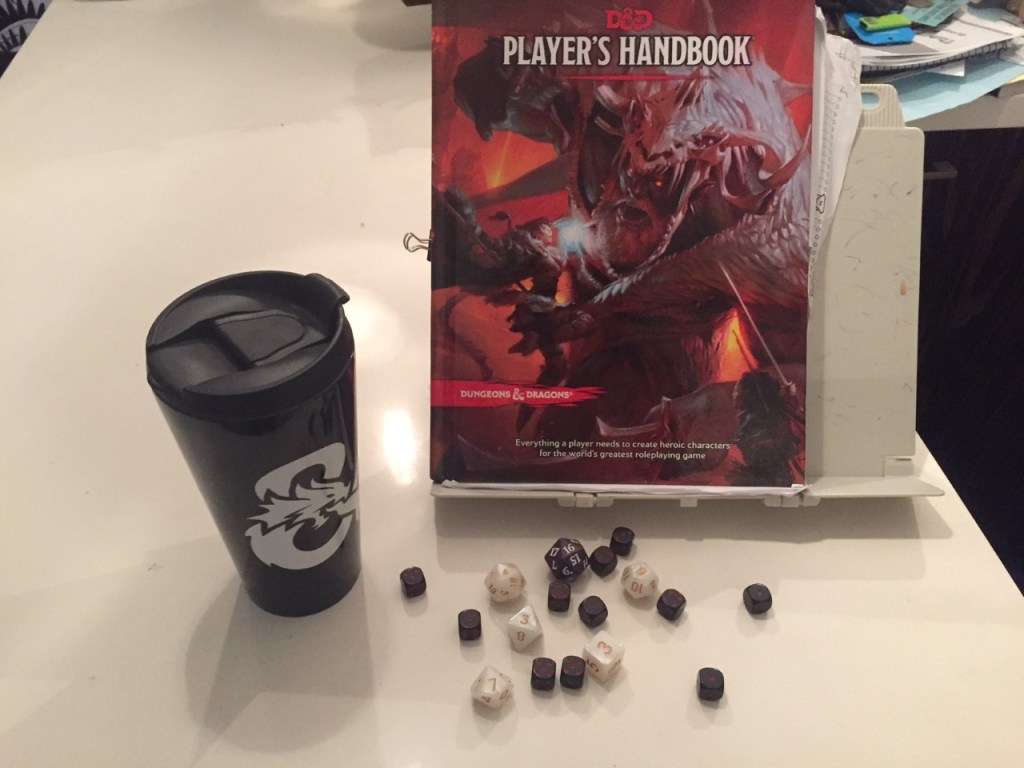
(Photo taken by blogger)

If you’ll allow me to diverge a little from this blog’s regular focus, I would like to talk about something that is very near to my heart. The tabletop roleplaying game (RPG) Dungeons & Dragons has been a part both of my personal life and my life as an educator for quite a long time now. I have had overwhelmingly positive experiences with it in both contexts and I would love the chance to share those experiences here with you. Hopefully I may even convince you to try the game with your own students.

Dungeons & Dragons is a role-playing game, one of the first of its kind in fact. The game itself originated in the mid 70’s when Gary Gygax and Dave Arneson wanted to create a formalised version of the adventures that they would invent together with their collection of miniatures (Wizards of the Coast, 2019). Though having its origin in the 70’s, the game is experiencing a significant resurgence in popular culture.

Now this is not a video game. Nor is it anything to do with Monopoly or Clue. In fact, the comparison I usually turn to when explaining the game to friends or students is to being in a play. It’s as if you are all characters in a fantasy adventure novel, only you actually have control over what your character says or does as part of the story. There are two major roles within D&D, the players and the dungeon master. The dungeon master is the one who tells the story. They act as the narrator, setting the scene, designing the world that the story is set within, and playing the role of anyone that the players may encounter along the way. The players are the heroes of the story, each inhabiting the role of an adventurer that they have built and responding to the story as that character. If you want to hear a better explanation of this, and see the game in action in a school context, I would strongly recommend teacher Bill Allan’s Youtube series D&D with High School Students (Allan, 2017). The series follows Allan and his students as they create a D&D mini-series as part of a high school media assignment. A link to this excellent series can be found here.

My own experience with Dungeons & Dragons started almost seven years ago. As is common in these stories, I had a group of friends who played the game and invited me over one night to play with them. I had the usually misgivings, when they explained the game I didn’t really get it, but I had heard about the game from mentions in television and I thought I would give it a try. I fell in love. The real magic of D&D isn’t that you experience a fantasy story, but that you do so together. It’s a massive social undertaking that requires teamwork, communication and the very precious ability to allow others to speak. But when you manage to achieve something together, the reward is well worth the trouble.

This is the very reason that the game can be so beneficial to young people. It allows students to explore the more nuanced side of social and emotional interactions at a time when those things do not come easy; and crucially it allows them to experience this as someone else. You can be surprised how much easier to it is to put yourself out there when you are speaking as Waynewright, the half-elf rogue, rather than Sam the scared teenager. Confronting your social fears through the guise of someone else is actually a common technique in child therapy and Dungeons & Dragons can be used in the same way (Blackmon, 1994; Raghuraman, 2000). I have actually written about the use of D&D as a form of bibliotherapy myself as part of my ongoing masters degree.

To give you a more anecdotal example of the educational power of Dungeons & Dragons, I myself have been implementing it with primary school children as part of my role as an outside school hours carer. Since my first game with a group of four interested students, Dungeons & Dragons club has grown into a thriving community of 15-20 students aged from 5 to 12. Yes, I have 5 year olds in my group and they are fantastic. The game allows those smaller children to experience what it is like to be the big hulking heroes that everyone depends on and it is truly a joy to watch. I have students who wouldn’t look twice at each other on the playground happily slaying monsters together.

Don’t get me wrong, it can be difficult to convince the younger students that not all problems can be solved by smashing them. But when you do get them talking to each other and taking the social route around an obstacle, it is definitely worth it. So go on, embrace your inner story teller and introduce the game to your students. You might be wary at first, but I guarantee you’ll love it.

References

Allan, B. (2017, December 18). D&D with High School Students S01E01 – DnD, Dungeons & Dragons, newbies. Retrieved from Youtube: https://www.youtube.com/watch?v=52NJTUDokyk&list=PL-e8SjU6Hfttkld80Wixe4qLrUAM0sjze

Blackmon, W. (1994). DUNGEONS AND DRAGONS – THE USE OF A FANTASY GAME IN THE PSYCHOTHERAPEUTIC TREATMENT OF A YOUNG-ADULT. American Journal Of Psychotherapy, Vol.48, 624-632.

Raghuraman, R. S. (2000). Dungeons and dragons: dealing with emotional and behavioral issues of an adolescent with diabetes. The Arts in Psychotherapy, Vol.27, 27-39.

Wizards of the Coast. (2019, November 3). What is D&D? Retrieved from Dungeons & Dragons: https://dnd.wizards.com/dungeons-and-dragons/what-is-dd

A Filmmaker’s Inaccuracy, can be a Science Teacher’s Opportunity

You would be hard-pressed to find a more effective cultural touchstone than film. Whether we are young or old, rich or poor, student or teacher; chances are we’ve gone to the movies. Personally, I think I may be one of those people that goes to the movies a little too much, and it is almost inevitable that they would creep into my teaching as well. You may have heard me discuss the strong effects that tapping into your students’ passions and interests can have on their engagement (Hurt, 2015). It can allow you to break down that invisible barrier that can exist in students’ minds between the science and maths that they learn in class, and the outside world that they go home to. Breaking out a film clip, as part of a class discussion or investigation, is an excellent and reliable way to achieve this.

If you’re a science or maths teacher looking to use film clips in class, there has never been a better time to start than right now. For whatever reason, be it the increase in politicised science or people’s increasing reliance on technology they don’t understand; scientists are no longer relegated to the background in film and television. Gone are the days when a scientist on the silver screen would mutter something vaguely diabolical, push back his tufts of white hair and throw a comically large switch. We have experienced a cultural shift that has now resulted in scientists being played as fully developed and relatable characters (Kirby & Chambers, 2016). One of the more significant examples of this would be in Avengers: Endgame, the highest grossing film of all time (Clark & Lynch, 2018). In a film filled with aliens and monsters, it’s a human engineer who takes centre stage. The film also introduces the concept of a Mobius strip for all you maths teachers out there. If you are a STEM teacher, this all means that you have a deep reserve of moments in film to engage your students with.

The best part is that you don’t even need the science in your clip to be accurate in order for it to be instructive. The main purpose of the clip is to simply engage your students and get them invested in understanding the scientific concept that the clip deals with. There is research that backs this approach up from an academic perspective whether the clip gets the science concept right or wrong (Hillyard, 2007, Ludwig, 2012, Rose, 2007).

Let’s look at one example of a science inaccuracy in a film that makes for a great engagement tool for teaching Year 9 and 10 physics. This particular example comes from the film Gravity (Cuarón, 2013). A movie so steeped in STEM related concepts that its very name is taken from one of the fundamental physical forces of the Universe. Gravity is a gripping tale of an astronaut’s struggle to survive on her own in low earth orbit. Except, if Newton’s laws of motion were to have been obeyed, she never would have been alone in the first place. Our hero, played by Sandra Bullock, watches fellow astronaut George Clooney bravely sacrifice himself by cutting himself loose from a rope that he and Bullock are hanging from, this saving her life. It’s a dramatic scene. Unfortunately for Clooney, he isn’t hanging off a cliff with gravity pulling him down, he’s in space. The more mundane reality is that he would simply bounce back to his fellow astronaut as soon as the rope became taut. I don’t think that would have been quite as epic, but it would have been much more scientifically accurate though.

Presenting a clip of this incident at the beginning of class, and asking whether students think this is what should have happened, is all it takes to engage a class in genuine scientific inquiry. So if you, like me, have ever walked out of a perfectly good film and annoyed everyone by questioning its scientific accuracy; bring that discussion into the classroom. With the proper planning, that may just be the best place for it. 

References

Clark, T., & Lynch, J. (2018, April 5). The 10 highest-grossing movies of all time, including ‘Avengers: Endgame’. Retrieved from Buisness Insider Australia: https://www.businessinsider.com.au/highest-grossing-movies-all-time-worldwide-box-office-2018-4?r=US&IR=T

Cuarón, A. (Director). (2013). Gravity [Motion Picture].

Hillyard, C. (2007). Using Popular Culture to Teach Quantitative Reasoning. PRIMUS, 36-43.

Hurt, J. (2015). Utilizing Students’ Passions and Interests to Create a More Meaningful Research Experience. Delta Kappa Gamma Bulletin, 37-40.

Kirby, D., & Chambers, A. (2016, October 20). The Road to Scientific Imagination: Connections between Science and the Movies. Retrieved from From the Lab Bench: http://www.fromthelabbench.com/from-the-lab-bench-science-blog/2016/10/20/the-road-to-scientific-imagination-connections-between-science-and-the-movies

Ludwig, K. (2012). Using Pop Culture to Teach Biomechanics. Journal of Physical Education, 27-30.

Rose, C. (2007). Biology in the Movies: Using the Double-Edged Sword of Popular Culture to Enhance Public Understanding of Science. Evolutionary Biology, 49-54.

When in Doubt, Star Talk it Out

If you dive into the research surrounding youth and popular culture, it won’t be long before you come across the term ‘participatory culture’. It’s a term coined by researchers like Jocson (2018) to describe the way platforms like Youtube, Twitter and Instagram (or WordPress in my case) have changed culture today by making it so easy to create content. In the world that we now live in, essentially anyone with an internet connection has a voice, even lowly student teachers. For the most part, this phrase gets invoked when discussing our students. It can be used as part of a critique on youth being overwhelmed by information and not knowing what is real and what is fake (Notley & Dezuanni, 2017). Or if you are looking for how social media can benefit education like we are; ‘participatory culture’ can be pointed to as a way to facilitate students becoming engaged creators themselves (Jenkins, 2016).

What gets less talked about, is that this same ‘participatory culture’ is there to benefit teachers just as much. Whilst social media has given some very loud and very misguided people a platform; it has done the same thing for scientists and science communicators. These science communicators have already devoted a significant portion of their time and energy teaching STEM principles by framing them within popular culture. If you are ever struggling for ideas in the classroom, these are the people that can help you. Odds are that they are already visible to the students in your classroom as well. Science communicators like Neil deGrasse Tyson (@neiltyson, 2019) , Brian Cox (@ProfBrianCox, 2019) and Australia’s own Dr Karl (@DoctorKarl, 2019) have even become celebrities on social media in their own right. Neil Tyson alone boasts a twitter following larger than the populations of both Queensland and New South Wales combined (Population Australia, 2019)!

Staying with Dr Tyson for a little longer; if I were to recommend a place to start for a STEM teacher looking to engage with popular culture, it would have to be Tyson’s podcast and Youtube series: “Star Talk” (Curved Light Productions, 2019). Star Talk is a podcast series which is always hosted by at least one scientist and one comedian. Drawing on the wealth of knowledge that Tyson and his fellow scientists offer, the show attempts to tackle science questions and science in popular culture in an entertaining and easily digestible way. Star Talk can muster quite a pull with its guests as well, meaning that if your students don’t recognise the show, they’ll certainly recognise past guests like Avenger actor Paul Rudd or Pop icon Katy Perry.  Whatever your teaching area, you can be sure that there is a Start Talk episode that you could draw on or recommend to your students as a piece of stimulus. The tag line of the show is actually, ‘where science and pop culture collide’ (Curved Light Productions, 2019). To be perfectly honest with you, that probably would have been the tagline for this blog if it wasn’t already taken.

So if you like the idea of teaching STEM with popular culture, but are unsure where to start or what to say, ask a friendly neighbourhood science communicator for help. They are there for you as much as they are there for your students.

References

@DoctorKarl. (2019, November 1). Retrieved from Twitter: https://twitter.com/DoctorKarl?ref_src=twsrc%5Egoogle%7Ctwcamp%5Eserp%7Ctwgr%5Eauthor

@neiltyson. (2019, October 5). Retrieved from Twitter: https://twitter.com/neiltyson?lang=en

@ProfBrianCox. (2019, October 5). Retrieved from Twitter: https://twitter.com/ProfBrianCox?lang=en

Curved Light Productions. (2019, November 1). Retrieved from Star Talk Radio: https://www.startalkradio.net/

Jenkins, H. (2016). Participatory culture in a networked era : a conversation on youth, learning, commerce, and politics. Cambridge: USA : Polity Press.

Jocson, K. M. (2018). Youth media matters : participatory cultures and literacies in education. Minneapolis, Minnesota: University of Minnesota Press.

Notley, T., & Dezuanni, M. (2017). Most young Australians can’t identify fake news online. The Conversation.

Population Australia. (2019, Novemeber 1). Retrieved from http://www.population.net.au/population-of-queensland/

What to Do When the Principal Comes Knocking

We have all had those moments, whether it be while quickly closing a poorly vetted Youtube clip or during a difficult behaviour management situation, when you are just hoping that the principal doesn’t pick that very moment to stroll by  your classroom. For a very long time, this was how I felt while teaching with popular culture.

I can remember tutoring a particular maths student who had a brain like a Casio fx-82, but not much interest in his maths homework. Luckily for both of us, what he did have was an interest in gaming. Having played a fair amount of video games in my own life, I was able to convey many different maths concept to him using games as vehicle for his learning. In one instance, I remember having a very in-depth discussion on calculating the intercept points of linear equations, all from a question he had on ‘weapon scaling’ in a game we were both playing. I knew that having these discussions were helping him, but it still felt like cheating to me. Somewhere in my brain, there was a vestigial connection between talking games and wasting time. As a result, I would worry about parents walking by during our discussions in the same way that a teacher thinks about the principal walking past the door. Now, that worry might be justified when you’re wasting time with something totally irrelevant, but neither you nor I should feel that when using a piece of Popular Culture to deliberately teach something.

If you have access to something that increases student interest in maths and science, you should use that tool. Especially if that interest is born from such a positive place. Whilst you may be able to elicit engagement from a student by letting them know that the contents of a lesson will be on an exam, that is a different ‘flavour’ of interest you are peaking. It’s the same kind of interest that comes from a job that needs to be done, not from one that you want to do. That brand of interest works to an extent; but its lacking in that creative drive that comes from something that you are genuinely passionate about. Teacher Joyce Hurt has a written a great article on the power of drawing from students’ passions and I encourage you to give it a read (Hurt, 2015).

On an even more basic level, teachers exist to prepare students for the world that they live in. I think this is especially true for science and maths teachers. Scientists are in the business of decoding the Universe, and mathematicians study the code that the Universe is written in. We cannot ignore the fact that our students live in a Universe where movies about astronauts are seen by millions (scientific accuracy not necessarly included); over 60% of Australian teens are gathering their news on social media rather than the papers(Notley & Dezuanni, 2017); and the President of the United States is making major political announcements on Twitter. This is a Universe where being scientifically and mathematically literate can greatly increase a society’s ability to thrive rather than struggle when faced with the wealth of information that is available (Tyson, 2017). We as teachers have the ability to cultivate that literacy in our students.

Of course, if you are a teacher trying to justify incorporating Popular Culture, you can always pull out the big guns….I’m talking about going all Curriculum on this sucker. Both the maths and science sections of the Australian Curriculum contain sections that can help you in this regard. If you are a science teacher, the Science as a Human Endeavour content descriptor is the place to start (ACARA, 2014a), as it discusses student understanding of how the methods of science are used to justify public debate. For maths teachers, the ‘Numeracy’ skill actually specifically addresses investigating claims made in the media (ACARA, 2014b). The connections are there to be made, and we all know the bureaucratic punching power that comes from having the curriculum on your side.

What I am trying to say is that when the principal comes knocking, and you are in the middle of debating whether the latest Avengers film respects Newton’s third law; just invite them in. There is nothing that you should be worried about, and plenty that you can say.

References

Australian Curriculum, A. a. (2014b). Mathematics. Retrieved from https://australiancurriculum.edu.au/f-10-curriculum/mathematics/

Australian Curriculum, Assessment and Reporting Authority [ACARA]. (2014a). Science. Retrieved from https://australiancurriculum.edu.au/f-10-curriculum/science/

Australian Curriculum, Assessment and Reporting Authority [ACARA]. (2014c). Literacy. Retrieved from https://australiancurriculum.edu.au/f-10-curriculum/general-capabilities/literacy/

Hurt, J. (2015). Utilizing Students’ Passions and Interests to Create a More Meaningful Research Experience. Delta Kappa Gamma Bulletin, 37-40.

Notley, T., & Dezuanni, M. (2017). Most young Australians can’t identify fake news online. The Conversation.

Tyson, N. D. (2017, April 19). Science in America – Neil deGrasse Tyson. Retrieved from Youtube: https://www.youtube.com/watch?v=8MqTOEospfo

Design a site like this with WordPress.com
Get started